Two Flags, Same Wind
When Politics Costs Us Each Other
Michael “Gene” Scott •
Whenever I meet someone down and out, I remind myself that I don’t know their story.
The kid covered in tattoos sporting green-spiked-rooster hair was raped by two men in his neighborhood when he was eight. Didn’t tell his dad because he’d shoot the perps on the spot. The guy serving life only cracked his father-in-law over the head with a baseball bat after watching him assault, rape, and beat his mom for a decade. You learn this by serving in a prison ministry, and I taught creative writing to lifers for a decade.
I grew up in middle America, fifty miles due north of Peoria, Illinois, in a little town named Sheffield, founded in 1852 as a railroad-and-coal town backed by two self-made Eastern businessmen, Joseph Earl Sheffield and Henry Farnam.
Neither had much formal schooling — Sheffield learned commerce, Farnam engineering — but together they pushed the Rock Island Railroad west across Illinois. When it came time to name the settlement, they flipped a coin. Sheffield won. Farnam got the principal east-west street, and somebody eventually stuck an extra H in it.
They differed politically. Sheffield called himself an old-line Whig and opposed abolitionism, though he opposed slavery in principle. Farnam ran friendlier to the abolitionists and helped Josiah Bushnell Grinnell establish his settlement in Iowa. They disagreed about the great moral question of their century.
Then they built a railroad together.
Illinois gets the “radical left” rap, but it’s deeply Republican ten miles south or west of Chicago. The Bureau County Republican is the local paper. Two relatives fought with the Illinois 93rd under Sherman. Michael Batdorf left a wife and three children, was captured at Missionary Ridge, and died at Andersonville. His brother Johnathan came home with his face torn open.
Republicans who gave their lives to end slavery.
That was when the Democrats loved slavery. The two parties spent thirty years swapping places, and the South took longest of all, which is a harder thing to fit on a meme. Most folk today are bamboozled about the ideological swap, and power-grifters take advantage of that with endless bullshit memes: Republicans freed the slaves. Democrats fought to keep them. Nothing has changed. The KKK was founded by Democrats. Remember that the next time Democrats call Republicans racist.
Drool.
Downstate Illinois is much more like Alabama than Chicago.
An exaggeration, for sure. But let me hold up an example.
When my parents’ 25th wedding anniversary rolled around, I threw a party for them at their sharecropper “farmhouse.” Jack Weber, who inherited the brick yard and owned the ground, took half the proceeds of our labor for letting us farm it and live in a drafty coal way-station shack. I’d wake up in the winter with a little tuft of snow on the bedcovers after the wind broke through loose windows. Gifted an electric blanket one Christmas, I deemed it the greatest invention ever conceived.
We roasted a hog and set up a keg of beer and the cars rolled in the driveway. Friends from town and the surrounding farmers turned out, and we spent a pleasant afternoon laughing and reminiscing.
Then a carload of Black men pulled up.
Dad was a working man from childhood. He milked twelve cows by hand before high school classes began, then delivered the glass quarts to customers in Perry, Missouri, after my grandmother and Aunt Janet pasteurized the milk. He milked again after school, then ran to town for basketball practice. He could dunk as a freshman, and no one ever took the ball away from him. He played for the National Guard for ten years and retired as a Master Sergeant. He only avoided Vietnam because his unit was the last to leave Europe after the war, so they sat on the back burner until the mayhem ended.
He valued the working man, no matter their creed, color, or religion.
Jack Weber — who graduated from Evanston Township High School, one of the best in the country at the time, and where I would later teach debate and write the developmental reading program — ran the brick yard and cement factory with Dad and Mick DeFauw, who deserves his own essay. They didn’t have the cash for a forklift, so every morning they lugged a railcar of ninety-pound cement bags into the shed, one bag up on each shoulder, before work began at six. It broke my dad down over time. His bones thickened under the pressure and bore bad fruit later in life. When Jack came down with polio, Dad carried him up and down the Board of Trade building in Chicago once a month, there being no handicap ramps in the mid-fifties.
The men who made the bricks and mixed the concrete were Black men from Kewanee, sixteen miles away. Hard workers, easy to get along with, hilarious in conversation.
How do you spell kerosene? Dad asked one morning.
I don’t know, one of them said, but I think it’s about this long — and he held his thumb and index finger an inch apart.
Those were the men who pulled into the driveway. Our family went out and met them with hugs and slaps on the back.
Half the Sheffield crowd got up, jumped in their cars, and slung gravel off their rear tires until they reached the highway.
Alabama.
I am a Blue Dog Democrat, which in my version means fiscally responsible and socially liberal. A Republican who likes people. Pay the bills, help the ones who need help, and don’t tell anybody what book to read, whom to love, or what church to attend, if any.
That used to leave room for disagreement.
Now everybody wants your papers.
What do you think about Trump? Abortion? Guns? Transgender people? Israel? Immigration? Climate?
You can almost see the clipboard.
Check enough of the wrong boxes and you’re no longer mistaken. You’re bad.
It cost me a job when I moved to Tennessee.
I taught comprehension skills for seven years at Northeast State Community College (Blountville, Tennessee) to area high school graduates who sometimes couldn’t read the diplomas they’d been handed. The developmental studies program was the largest on campus, and the faculty elected me president, which meant driving to Nashville once a month for meetings.
One day I sat in a meeting with our college president, Dr. Wade Powers.
Looks like the Muslims are going to give the opening prayer at East Tennessee State’s graduation this spring, he groused.
The room grumbled and shook its head. What a travesty. How un-American.
After a few seconds of stunned silence, I said:
I thought we were supposed to be educators. People who value an education? Do we believe in the Constitution? Really? There’s this thing called the First Amendment. Why do you think persecuted religious groups emigrated to America in the first place?
Then I looked at the vice-president, Maurice Stirewalt. I liked him. He came across tough, unyielding, demanding as hell, but once you stood up to his bullshit he’d embrace you for your courage.
What was your major, Dr. Stirewalt?
History, he said.
And you’re going to remain silent?
He remained silent.
At that moment I knew my tenure vanished. The administration denied it at the end of my seventh year, though they were supposed to rule after six.
Three years later, in 1999, I spent a month in Bangladesh on a Rotary International trip, surveying wells Rotary dug with donations from America. Many were full of arsenic. The country sits at the bottom of the Himalayan drainage, and safe water is not the simple matter it is when you turn a tap in Tennessee.
I lived with Muslims all over that country. Homes, meals, long conversations, longer car rides.
They acknowledged Christ as a great prophet and believed in His way of living. Love God, love your neighbor. They just didn’t think He was divine. We agreed on the one God, though splitting Him into thirds made them frown. Three equals one and one equals three didn’t cut the math test. They came up with those Arabic numerals, after all. I respect the objection, though I remain a God-Jesus-Holy-Spirit kinda guy. Never was good at math as I suffer from dyscalculia, ironic for one treating dyslexia.
That month changed me.
In Stolen Pride, a National Book Award finalist in 2024, Arlie Russell Hochschild put her finger on when the knives came out: political parties stopped being coalitions and became identities. Disagreement inside the party turned into betrayal. Disagreement outside it turned into hostility. Compromise turned into surrender.
I didn’t need the book. I’d lost three friends to the same issues.
The first is a man I admire for more reasons than I can list here. He said it to me plainly one day, the way you’d say you take your coffee black: I believe everything Rush Limbaugh says. Everything. I walked away with tears in my eyes.
The second earned a Silver Star in a firefight in Afghanistan. I know something about what that costs and what it says about the man who earns one. He joined the Oath Keepers. I kept my distance, but cried at his funeral while his friends shot me the stink eye.
The third sits beside Steve Bannon and repeats the same fascist garbage. I lost him, and it still hurts.
Politics used to be the thing people argued about.
Now it decides who stays in the room. A conservative criticizes Trump and becomes a RINO. A progressive questions the line and becomes a sellout. One wrong sign, one wrong vote, and somebody you ate supper with for twenty years turns into a misty memory.
The strange part is that people at opposite ends behave exactly alike while swearing they share nothing.
Sheffield and Farnam disagreed about slavery.
Then they laid track west.
For years I would have held them up as proof that Americans once knew how to disagree.
Now I look at them differently.
One man was willing to keep working beside another man whose position on slavery should have been intolerable.
Maybe that was maturity.
Maybe that was a compromise.
Maybe that was cowardice.
Maybe a railroad got built because somebody swallowed something he should have spit out.
I don’t know.
I know only that they kept building.
I know that when three men I loved crossed lines I could not cross with them, I did not.
I walked away.
And here is the part I cannot make tidy:
I still believe the first sentence of this essay.
I don’t know another person’s whole story.
Not the prisoner.
Not the Muslim.
Not the racist who threw gravel out of my parents’ driveway.
Not the friend sitting beside Steve Bannon.
Knowing the story does not erase what somebody does.
But refusing to know it makes leaving much easier.
Sheffield and Farnam kept laying track.
I didn’t.
Somewhere between those two facts is a price.
I’m not sure yet who paid too much.
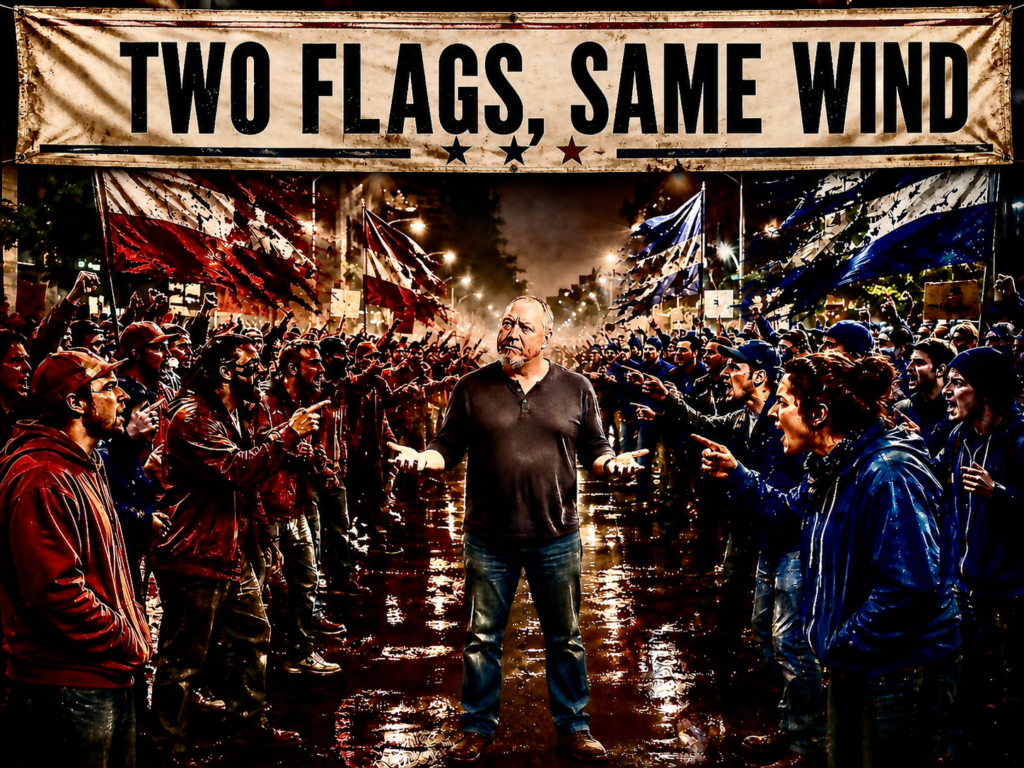
Different Flags, Same Wind
They painted out a name downtown
By noon, no one asked at all
One face was gone from the old frame
No one there would say the name
A boy came late into the chant
Felt every eye turn where he stood
Across town, she checked the hall
Then told her friend with the curtains drawn
A chair drags slow
A face turns cold
The room gets small
No one is told
Different flags, same fire
Different words, same choir
One voice drops, the rest sing on
Every face knows something’s wrong
No one speaks, no one needs a word
One head turns, then the whole row turns
The banners pull as night comes in
Different flags in the same wind
A man up front said, “That’s enough”
Not very loud, but loud enough
The people near him stopped the song
Then turned as one to prove him wrong
Across the street, one voice broke free
One wrong word, one note off-key
A sign slipped loose and hit the ground
No one bent to pick it up
No hand goes high
No word goes round
They know the face
They know the sound
Different flags, same fire
Different words, same choir
One voice drops, the rest sing on
Every face knows something’s wrong
No one speaks, no one needs a word
One head turns, then the whole row turns
The banners pull as night comes in
Different flags in the same wind
Back home, the sign leans by the door
Mud dried white along the floor
The room is still, the street is not
Their voices carry through the glass
I take my jacket from the chair
Your name is written everywhere
I learned my name by naming you
Now the room goes quiet too
Smoke hangs low beneath the lights
Paper signs scrape through the night
Someone knots a torn flag tight
No one turns to look behind
Past the glow, the street runs thin
Still they march against the wind
Two crowds calling through the dark
Long past where the street should stop
Different flags, same fire
Different words, same choir
One voice drops, the rest sing on
Every face knows something’s wrong
No one speaks, no one needs a word
One head turns, then the whole row turns
The banners pull as night comes in
Different flags in the same wind
The shouting carries past the edge
The banners bend
Different flags
In the same wind
References
- Yale University, Yale and Slavery Research Project, biographical research on Joseph Earl Sheffield.
- Henry W. Farnam, Memoir of Henry Farnam (1889).
- Historical accounts of Josiah Bushnell Grinnell and Henry Farnam’s role in the development of Grinnell, Iowa.
- Arlie Russell Hochschild, Stolen Pride (2024).
